
Executive Search Manufacturing Mexico
What executive search manufacturing Mexico looks like in 2026 — how a retained plant-leadership search runs and why the right candidate is rarely looking.
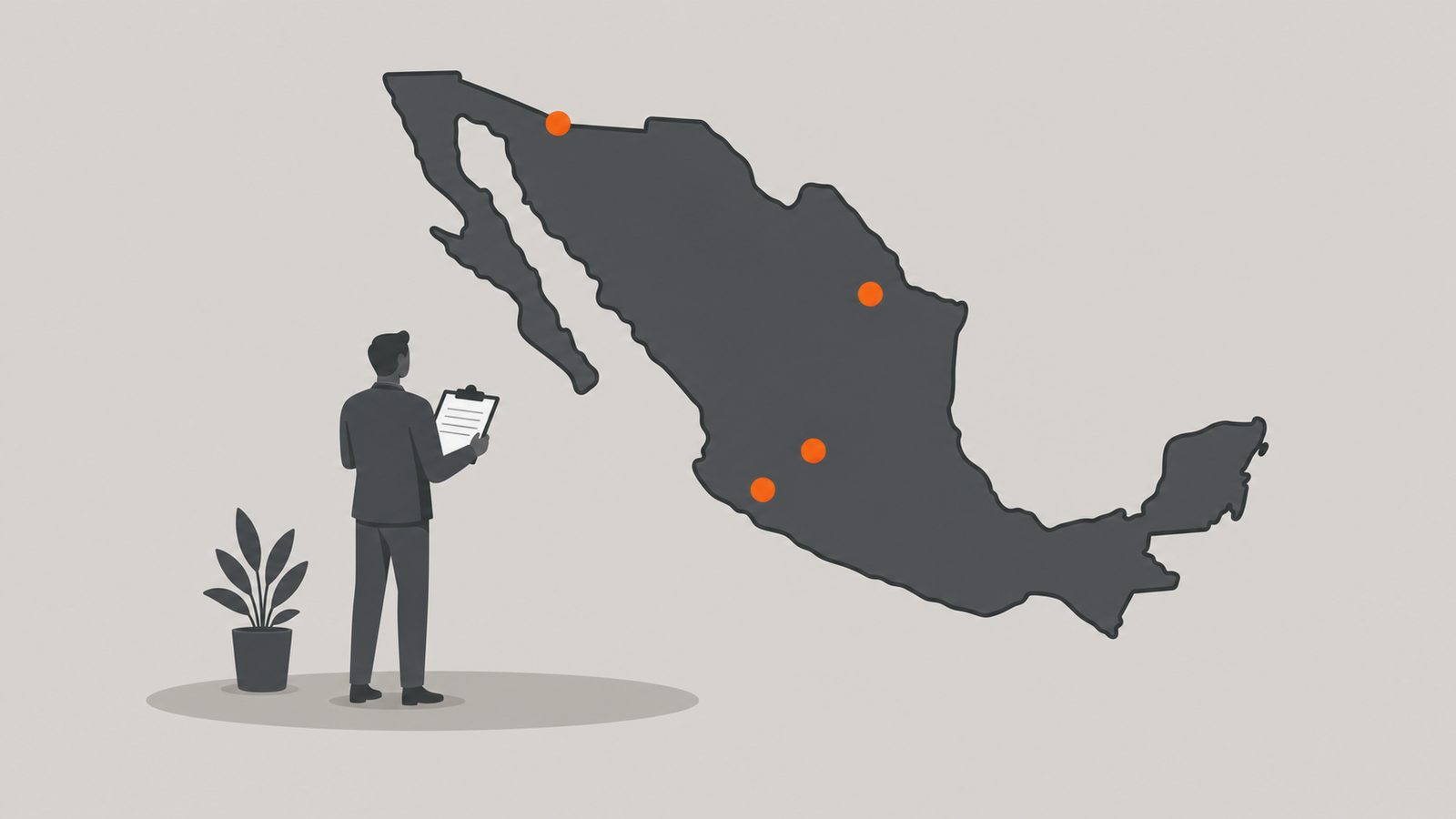
A US, European, or Asian manufacturer rarely engages an executive search firm in Mexico out of curiosity. The call comes when a plant is drifting, when the VP of Operations quits without a successor, when the board approves a Bajío expansion with no leadership plan in place, or when a quarterly review with headquarters exposes that the current plant director is not going to make the next stage. At that moment, the problem is not “find someone” — it is do not miss on a decision that will take eighteen months to reveal whether it was made well.
This piece is an honest description of what a retained executive search manufacturing Mexico engagement actually does — and does not do. The distinction matters. Mexican buyers use “headhunter” colloquially for both a contingent recruiter cold-calling on LinkedIn and a senior firm engaged under a retainer. They are different products serving different problems.
The 2026 operating context that raises the stakes
Setting matters before process. In the first quarter of 2026, Mexico attracted a record USD 23.59 billion in foreign direct investment, up 10.4 percent year over year, with manufacturing capturing 41.2 percent of the total (Secretaría de Economía, May 2026). Nuevo León grew 72.9 percent as an FDI destination in 2025, and the Bajío consolidated more than 14.7 million square meters of industrial inventory in Q1 2026 (García y Asociados market study, June 2026).
At the same time, employment in Mexico’s IMMEX export-manufacturing establishments accumulated 26 consecutive months of year-over-year declines through early 2026, with particularly sharp retrenchment in transportation-equipment and apparel manufacturing (INEGI via Milenio, April 2026). Industrial vacancy in the north jumped from 1 percent in 2023 to 7 percent in 2025 (Inmobiliare / Prodensa, June 2026).
These figures do not describe a linear “manufacturing boom” or a “manufacturing crisis.” They describe a reconfiguration: fresh capital arrives while mature plants trim, apparel employment falls while electronics rises, and states with firm power, water, and gas are winning the next round of investment. In that setting, a bad hire at plant-leadership level is not fixed by turning over the layer below. It is fixed late and expensively. That is the problem a retained executive search manufacturing Mexico engagement exists to prevent.
What a retained search actually does
A well-run retained engagement has little in common with the popular image of a “headhunter” flipping through a Rolodex. It is a disciplined process built around five moves:
1. Translate the business problem into an executable profile. Before we approach the market, the real work is sitting with the CEO, the board, or the corporate sponsor and disassembling the search. Is this a manufacturing problem, a supply-chain problem, a commercial problem, or all three tangled together? Does the plant need an operator to stabilize or a transformer to redesign? Does the role report to Mexico, to a US parent, or to both — and how much of that duality does the candidate actually need to carry? Half of failed searches fail here, weeks before anyone is met.
2. Map the market, not the address book. Serious manufacturing executive search does not run off a database. It runs off a systematic corridor-by-corridor map — who runs which plant, who just moved, who is stuck one level below where they need to be, who has the passports (bilingual, bicultural, dual-reporting scars) in order. A fresh map per search, done corridor by corridor across Monterrey, Bajío, the border, and Guadalajara — not a saved list from last year.
3. Reach the passive candidate. The right industrial leader is almost never actively looking. They are running a plant that works. The search consultant’s job is to identify that person, enter through the right door, and sustain a months-long conversation until the opportunity crystallizes. That is the sole reason retained search exists as a product: the retainer pays for time in a market that does not answer advertisements.
4. Evaluate with shop-floor depth. This is where the technical background of the person leading the search earns its keep. A candidate for plant director or VP Operations has to be assessed in the language of manufacturing — takt time, OEE, model changeovers, launch discipline, labor-relations posture, Industry 4.0 maturity, IATF 16949 or FDA quality regimes depending on the sector. My own background in engineering and Demand Flow Technology certification enters at this stage: assessing an industrial executive is a boots-on-the-plant-floor job, not a conference-room exercise.
5. Support the integration. The search does not end on offer day. The first six months determine whether the placement holds, and a serious retained firm keeps structured contact with the candidate and the client through that window. Skip that step and the placement becomes next year’s search.
What a retained manufacturing search is not
Worth saying with the same clarity. A retained industrial executive search firm is not a contingency agency: it does not fire off three CVs in return for a fee at close, does not compete against four other firms for the same opening, and does not get paid only if someone signs. It is not a database: it does not live off “candidates on file” and it does not recycle shortlists from prior mandates. It does not replace HR: it works alongside it, but the ultimate decision-maker is always the CEO or the board. And it does not do transactional searches for operating-level roles — first-line supervisors and manufacturing engineers belong to a different channel.
In the manufacturing, supply chain, and industrial sales practice I lead in Mexico, the work is delivered through Alder Koten, with offices in Houston, Monterrey, Guadalajara, and Mexico City, and under The Dynamic Fit Method™ — Ability, Capability, Capacity. The discipline of the method exists precisely so that the evaluation of a candidate is not a matter of charisma or gut, but an explicit decomposition of what the executive can do, what they know how to do, and how much operating scale they can carry.
When retained search is the right instrument
Not for every hire. It fits when the role is senior — plant director, director of operations, VP manufacturing, director of supply chain, general manager of a Mexican operation. It fits when the qualified candidate pool is thin and mostly passive. It fits when a bad hire is materially expensive — an unwanted exit inside a year, twelve months of churn, a launch target missed. And it fits when the organization needs structured confidence in the decision, not speed.
For more generalist mandates, an internal talent team may be enough. Retained search earns its place when the weight of the decision exceeds what an in-house process can carry alone.
Frequently asked questions
How long does a plant director search take in Mexico? 12 to 20 weeks from kickoff to signature, depending on the corridor, the bilingual bar, and reference availability. Bajío searches tend to move faster than border searches; roles that require both US parent-company fluency and Mexican union scope typically land at the top of the range.
How is the retainer structured? In thirds: one at kickoff, one at shortlist, one at close. The structure keeps the firm incentivized to do the full search, not just reach the first yes. Total fees run as a percentage of the role’s annual cash compensation, agreed in writing before the mandate opens.
Does a Mexican search firm actually understand US or European headquarters dynamics? It has to. In a multinational’s Mexican operation, the candidate reports both ways and the evaluator must speak both governance languages. That is the minimum bar. Without it, the search produces candidates who impress in Mexico and do not survive the first quarterly review with headquarters.
What does a firm with corridor offices offer that a Mexico-City-only firm does not? Presence in Monterrey, Guadalajara, and Bajío means the consultant has actually walked the plants, knows the local operators, understands the regional comp curves, and reaches networks a single-office firm cannot cover. Mexico’s industrial corridors are not one market — they are four distinct markets.
Silvia Flores is Managing Partner at Alder Koten, leading executive search for manufacturing, supply chain, and industrial sales in Mexico.
If your organization is weighing a leadership search in manufacturing, supply chain, or industrial sales in Mexico, let’s talk.