
Farnborough 2026 — Day 2 Field Notes
Day 2 at Farnborough: $22B more in deals, IndiGo's record LEAP order, Anduril–Embraer on the C-390, and JobsOhio's Beehive expansion for 3D-printed engines.
Farnborough 2026 — Day 2 Field Notes
Farnborough, 21 July 2026. Day 2 shifted register. The frenetic order theatre of Monday gave way to a steadier rhythm — $22.1 billion in additional deals, a wider spread of smaller commitments, and the defense agenda finally taking its share of the room. Cooler weather, longer conversations. If Monday was about who was buying, Tuesday was about what a modern aerospace and defense industrial base actually looks like.
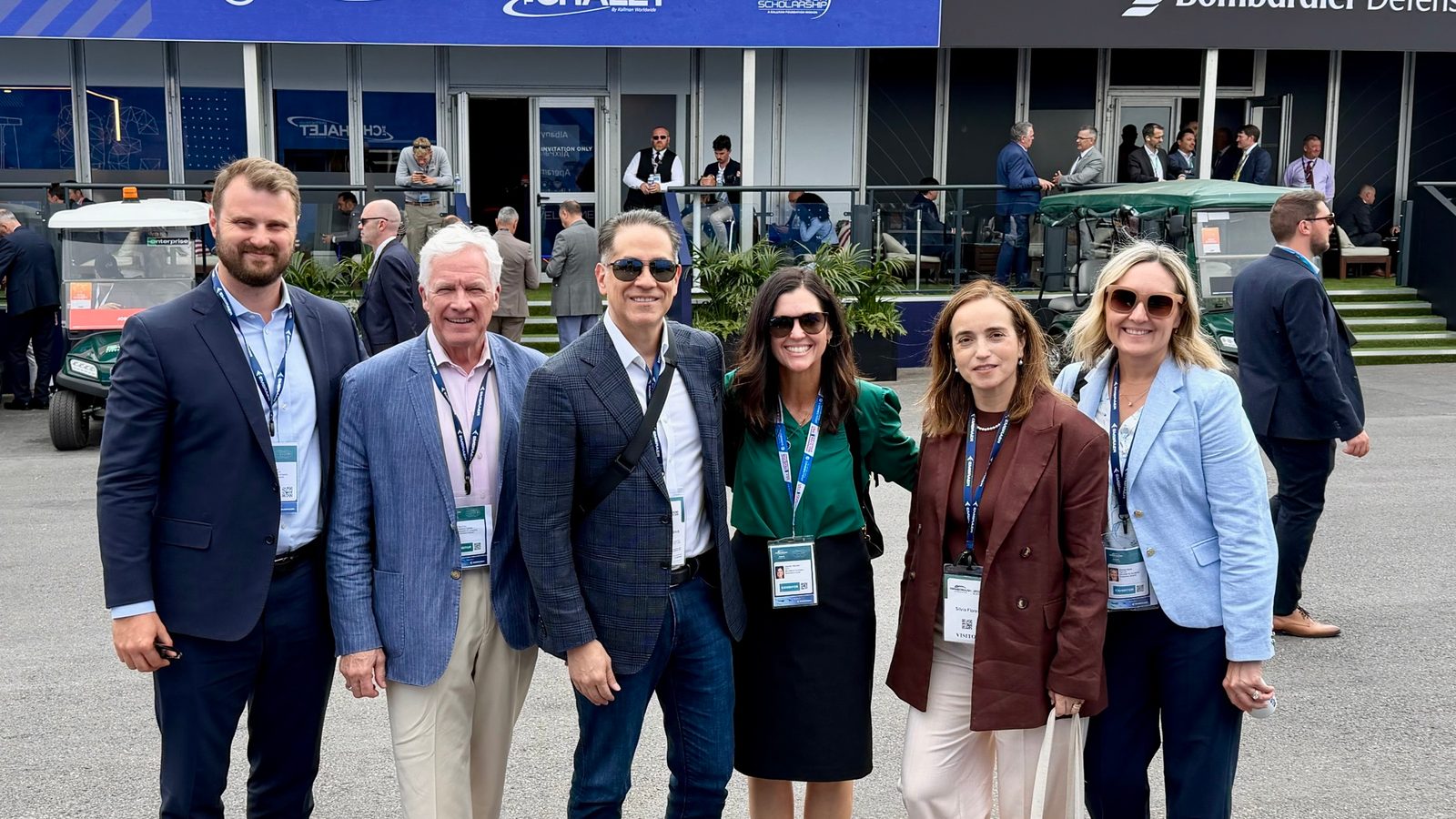
We spent much of the day at the Kallman Partnership Chalet — the state-of-Ohio pavilion co-hosted with JobsOhio, J.F. Lehman & Company, and the Endeavour Scholarship — where the announcement of the day for the leadership-hiring conversation was made mid-morning: Beehive Industries committed $70 million to expand its Southwest Ohio operations for 3D-printed jet engines, adding more than 200 new jobs. Governor Mike DeWine and JobsOhio made the announcement from Farnborough, not Columbus — a small but telling detail about where next-generation aerospace manufacturing is now negotiated.
The commercial headlines
The Embraer press briefing produced around 30 firm E-Jet orders across four operators, plus a landmark memorandum with Azorra for up to 30 E-Jet freighter conversions. Latin America drove the volume: Abra Group — parent of Avianca, GOL, and Wamos — confirmed a package for up to 45 E195-E2s, comprising 20 firm orders, 10 options, and 15 purchase rights. Spanish regional carrier Binter added five more E195-E2s. Luxair, which only began E2 operations in January, firmed three E190-E2s plus a purchase right. Japan’s Fuji Dream Airlines ordered two more E175s.
On the engine side, IndiGo’s memorandum with CFM International covers more than 1,000 LEAP-1A engines to power 510 A320neo-family aircraft — the largest single LEAP order in the program’s history if finalized. The airline paired it with a Honeywell agreement for avionics, APUs, and aftermarket support across 810 A320neos.
Airbus used the day to disclose that its Wing of Tomorrow research program will move to flight test on an A321neo starting in the second half of 2027 — the leadership implication for suppliers being that composite wing engineering, high-span aerodynamics, and next-generation certification skills are moving into the current hiring window, not a future one.
Widebody activity continued. AerCap ordered 15 more Boeing 787-9s with substitution rights to switch to the 787-10 later. Philippine Airlines doubled its A350-1000 commitment with an MoU for nine more aircraft and a matching Rolls-Royce Trent XWB-97 selection with a TotalCare maintenance package. Uganda Airlines placed its first-ever Boeing order — four 737 MAX 8s and four 787-9s. MSC Air Cargo committed to five 777-8 Freighters. Tajik startup Shohin Airlines emerged as the previously-undisclosed buyer behind four A320neo-family aircraft.
Defense moved to the center
The tempo we noticed on the floor was defense catching up to the exhibitor split announced at the show’s open. Lockheed Martin unveiled MORFIUS X-Rotor, a ground-launched microwave counter-drone platform capable of disabling more than 50 hostile drones in a single flight before returning to base for reuse — the reusable-per-mission economics matter more than the platform description. Lockheed also formally launched its lower-cost Patriot interceptor (PAC-3 ACE), announced during Monday’s opening.
The industrial-cooperation announcement with the greatest hiring signature came from Embraer and Anduril: an MoU to integrate Anduril’s Barracuda-500M cruise missile onto the C-390 Millennium, with a stand-off strike concept designed for palletized, large-scale, cost-effective employment. A Brazilian airframer, an American defense-technology company, a stand-off munition designed for scale-economics — this is the collision of commercial aerospace engineering culture and defense-tech culture that has been coming for two years, arriving explicitly on a trainer-transport that already flies in eight air forces.
Behind the announcements, BAE Systems + Boeing + Saab formalized a teaming agreement around the T-7 as a Royal Air Force Hawk replacement; Canada joined the Global Combat Air Programme (GCAP) as an observer; and Saudi Arabia’s The Helicopter Company signed a $2.9B letter of intent for up to 60 Bombardier fixed-wing aircraft, a strategic pivot from a helicopter-only operator.
What the conversations were really about
If Monday’s private conversations were dominated by the Mexico question, Tuesday’s were about workforce architecture. Every operator, every OEM, every tier-one supplier we sat with returned to the same underlying problem, framed different ways: composite technicians for wing-of-tomorrow programs, welders and CNC operators cleared to work on defense platforms, quality engineers who can navigate FAA + EASA + AFAC simultaneously, program managers who can hold a matrixed defense-and-commercial P&L.
Babcock’s engineering-skills panel — a joint initiative with Oxford University’s SKOPE centre, the Royal Academy of Engineering, and ADS Skills — put the same problem on a formal stage: the gap between engineering education and the sector’s evolving demands is now wide enough that OEMs are launching multi-institutional initiatives to close it, not just individual company programs. For a Mexico-focused practice, the read is direct: the bench-building question in the Bajío is a specific case of a global problem, not a Mexican peculiarity.
A recurring theme in bilateral meetings: program transfers into Mexico are increasingly conditional on the acquiring plant’s demonstrated engineering bench, not on labor cost. Two years ago the conversation was about landed cost per hour. Today it is about the credibility of the engineering signature that the plant can put on a certifying-authority filing. The corridor-by-corridor differentials — Bajío vs. border vs. Guadalajara — are becoming sharper, not softer, because those differences are now measured in engineering headcount and certification track record, not just in wages.
And then there is the piece nobody talks about on stage: the sustainability constraint. Air Canada and Airbus signed a joint initiative on Canadian SAF and hydrogen; Aeroméxico continues to build out its technical-decarbonisation agenda in parallel with its Honeywell partnership announced Monday. The technical-leadership profile that can hold both an operational P&L and a decarbonisation roadmap is scarce today, and the market rate for that profile is moving faster than the market rate for a conventional plant director.
What we’re watching for Wednesday
Day 3 is traditionally the most defense-heavy of the four industry days. The Aerospace Global Forum defense summit, next-generation propulsion sessions, and the space-and-satellite track all sit on Wednesday. We expect the first serious announcements around European sovereign-capability builds and additional defense-industrial reshoring commitments in the US Midwest.
We will publish the third set of field notes at the end of the day tomorrow, and a closing summary after the show wraps.
By Silvia Flores, Managing Partner at Alder Koten, leading executive search for manufacturing, supply chain, and industrial sales in Mexico. Alder Koten is a member of the IMD International Search Group, whose Aerospace Practice is represented at Farnborough 2026.
If you would like to arrange a conversation before we leave the show, please contact us.